

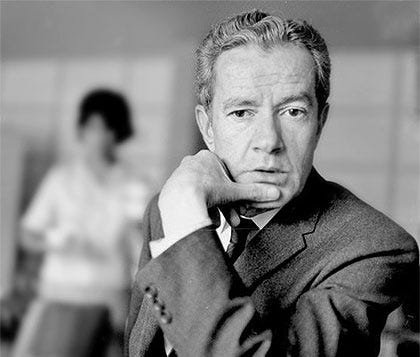
By Juan Rulfo
(Mexico, 1918-1986)
Originally published in the magazine América No. 66, August 1951 (The Plain in Flames, 1953)
Translated by Fausto Adams
“Tell them not to kill me, Justino! Go on, go tell them that. Tell them for mercy’s sake. Tell them like that. Tell them to do it for mercy’s sake.”
“I can’t. There’s a sergeant there who doesn’t want to hear anything about you.”
“Make him listen to you. Work your magic and tell him it is enough with the scares already. Tell him to do it for the love of God.”
“This isn’t about scaring. Looks like they’re really going to kill you. And I don’t want to go back there.”
“Go again. Just one more time, see what you can get.”
“No. I don’t feel like it. I’m your son. And if I keep going over there, they’ll end up figuring out who I am, and they’ll want to shoot me too. Better to leave things as they are.”
“Go on, Justino. Tell them to have a little pity on me. Just tell them that.”
Justino clenched his teeth and shook his head saying: “No.”
And he kept shaking his head for a long time.
Justino got up from the pile of stones where he was sitting and walked to the corral gate. Then he turned around to say:
“Fine, I’ll go. But if worst comes to worst and they shoot me too, who’s going to take care of my wife and kids?”
“Providence, Justino. Providence will take care of them. You worry about going over there and seeing what you can do for me. That’s what’s urgent.”
They had brought him at dawn. And now it was well into the morning, and he was still there, tied to a post, waiting. He couldn’t stay still. He’d tried to sleep a bit to calm down, but sleep had left him. His hunger had left him too. He didn’t feel like doing anything. Only living. Now that he knew for sure they were going to kill him, he’d gotten such a strong urge to live like only someone freshly resurrected could feel. Who would’ve told him that old business would come back, so stale, so buried as he thought it was. That business about when he had to kill Don Lupe. Not just for no reason, like the folks from Alima wanted to make it seem, but because he had his reasons. He remembered:
Don Lupe Terreros, the owner of Puerta de Piedra ranch, his compadre no less. The one he, Juvencio Nava, had to kill for that; for being the owner of Puerta de Piedra and, being his compadre too, denying him pasture for his animals.
First, he put up with it out of pure obligation. But later, during the drought, when he saw his animals dying one after another, tormented by hunger, and his compadre Don Lupe kept denying him the grass from his pastures, that’s when he started breaking the fence and driving the herd of skinny animals to the water holes so they could eat their fill. And Don Lupe didn’t like that, so he ordered the fence fixed again so that he, Juvencio Nava, would open another hole again. Like that, by day the hole would get patched and by night it would open again, while the cattle stayed there, always pressed against the fence, always waiting; his cattle that before could only smell the grass without being able to taste it.
And he and Don Lupe argued and argued again without reaching an agreement. Until one time Don Lupe told him:
“Look, Juvencio, one more animal you put in my pasture, and I’ll kill it.”
And he answered:
“Look, Don Lupe, it’s not my fault the animals look for their comfort. They’re innocent. Deal with it if you kill them.”
“And he killed one of my steers.
“This happened thirty-five years ago, around March, because by April I was already in the hills, running from the warrant. Not even the ten cows I gave the judge helped, nor lost my house to pay to get out of jail. Even after, they took what was left just to stop chasing me, though they chased me anyway. That’s why I came to live with my son on this other little piece of land I had called Palo de Venado. And my son grew up and married my daughter-in-law Ignacia and already had eight kids. So, this thing is old now, and by rights it should be forgotten. But apparently, it’s not.
“Back then I figured with about a hundred pesos everything would be settled. The late Don Lupe was alone, just with his wife and two little boys still crawling. And the widow died soon after, they say from grief. And the little boys were taken far away, to some relatives. So, from their side, there was nothing to fear.
“But the others took advantage that I had a warrant out and was being prosecuted to scare me and keep robbing me. Every time someone comes to town they’d warn me:
“‘There are some outsiders around, Juvencio.’
“And I’d head for the hills, hiding among the madrone trees and spending days eating purslane. Sometimes I had to leave at midnight, like dogs were chasing me. That lasted my whole life. Not one year or two. My whole life.”
And now they’d come for him, when he wasn’t expecting anyone anymore, trusting in how forgotten he was by people; believing at least his last days would pass peacefully. “At least this,” he thought, “I’ll get from being old. They’ll leave me in peace.”
He had given himself over to this hope completely. That’s why it was hard for him to imagine dying like this, suddenly, at this point in his life, after fighting so hard to escape death; after spending his best years running from one place to another, dragged by frights, and when his body had ended up just tough leather hide cured by the bad days when he had to hide from everyone.
Just in case, hadn’t he even let his wife leave? That day when he woke up to the news that his wife had left him; it didn’t even cross his mind to look for her. He let her go without asking anything about who with or where to, as long as he didn’t have to go down to town. He let her go like everything else had gone, without lifting a finger. The only thing left for him to take care of was his life, and he’d keep it no matter what. He couldn’t let them kill him. He couldn’t. Much less now.
But that’s why they’d brought him from there, from Palo de Venado. They didn’t need to tie him up to make him follow. He walked alone, only bound by fear. They realized he couldn’t run with that old body, with those skinny legs like dried stalks, cramped by the fear of dying. Because that’s what he was going for. To die. They told him so.
Since then, he knew. He began to feel that itch in his stomach that came suddenly whenever he saw death up close and that brought anxiety to his eyes, and that swelled his mouth with those mouthfuls of sour water he had to swallow unwillingly. And that thing that made his feet heavy while his head went soft and his heartbeat with all its strength against his ribs. No, he couldn’t get used to the idea of being killed.
There had to be some hope. Somewhere there might still be some hope left. Maybe they’d made a mistake. Maybe they were looking for another Juvencio Nava and not the Juvencio Nava that was him.
He walked among those men in silence, with his arms hanging down. The dawn was dark, starless. The wind blew slowly, taking the dry earth and bringing more, full of that smell-like urine that road dust has.
His eyes, which had grown dim with the years, kept seeing the earth, here, under his feet, despite the darkness. There on the earth was his whole life. Sixty years of living on it, of holding it in his hands, of having tasted it like one tastes the flavor of meat. He spent a long time breaking it down with his eyes, savoring each piece as if it were the last, knowing almost that it would be the last.
Then, as if wanting to say something, he looked at the men walking beside him. He was going to tell them to let him go, to let him leave: “I haven’t hurt anyone, boys,” he was going to tell them, but he stayed quiet. “Further along I’ll tell them.” He thought. And he just watched them. He could even imagine they were his friends; but he didn’t want to. They weren’t. He didn’t know who they were. He saw them at his side, leaning and bending down from time to time to see where the path went.
He had seen them for the first time at dusk, in that faded hour when everything seemed scorched. They had crossed the furrows stepping on the tender corn. And he had gone down for that: to tell them the corn was just starting to grow there. But they didn’t stop.
He had seen them in time. He always had the luck of seeing everything in time. He could have hidden, walked a few hours through the hills while they left and then come back down. After all, the corn wouldn’t make it anyway. It was time for the rain to come, and the rain wasn’t appearing and the corn was beginning to wither. It wouldn’t be long before it was completely dry.
So, it wasn’t even worth going down; having gotten among those men like into a hole, never to come out again.
And now he continued beside them, holding back the urge to tell them to let him go. He couldn’t see their faces; he only saw the shapes that pressed close or separated from him. So, when he started to speak, he didn’t know if they had heard him. He said:
“I’ve never hurt anyone” – that’s what he said. But nothing changed. None of the shapes seemed to notice. The faces didn’t turn to look at him. They continued the same, as if they’d come sleeping.
Then he thought he had nothing more to say, that he’d have to look for hope somewhere else. He let his arms fall again and entered the first houses of the town in the middle of those four men darkened by the black color of night.
“Colonel, here’s the man.”
They had stopped in front of the doorway. He, with his hat in his hand, out of respect, waiting to see someone come out. But only the voice came out:
“What man?” they asked.
“The one from Palo de Venado, Colonel. The one you sent us to bring.”
“Ask him if he’s ever lived in Alima,” the voice from inside said again.
“Hey, you! Have you lived in Alima?” the sergeant in front of him repeated the question.
“Yes. Tell the colonel I’m from right there. And I lived there until recently.”
“Ask him if he knew Guadalupe Terreros.”
“He says did you know Guadalupe Terreros.”
“Don Lupe? Yes. Tell him yes, I knew him. He’s dead now.”
Then the voice from inside changed tone:
“I know he died,” it said. And it kept talking as if chatting with someone there, on the other side of the reed wall:
“Guadalupe Terreros was my father. When I grew up and looked for him, they told me he was dead. It’s hard to grow up knowing that the thing we can hold onto to take root is dead. With us, that happened.
“Then I learned they had killed him with machete blows, then sticking an ox goad in his stomach. They told me he had been lost for more than two days and that when they found him thrown in a stream, he was still agonizing and asking them to take care of his family.
“This, with time, seems to be forgotten. One tries to forget it. What can’t be forgotten is finding out that the one who did it is still alive, feeding his rotten soul with the illusion of eternal life. I couldn’t forgive him, even though I don’t know him; but the fact that he’s put himself in the place where I know he gives me the courage to finish him off. I can’t forgive him for still living. He should never have been born.”
From here, from outside, it was heard clearly when he said it. Then he ordered:
“Take him and tie him up for a while, so he suffers, and then shoot him!”
“Look at me, Colonel!” he begged. “I’m not worth anything anymore. I won’t be long dying on my own, broken down from old age. Don’t kill me…!”
“Take him away!” the voice from inside said again.
“…I’ve paid already, Colonel. I’ve paid many times. They took everything from me. They punished me in many ways. I’ve spent about forty years hiding like someone with the plague, always with the feeling that at any moment they’d kill me. I don’t deserve to die like this, Colonel. Let me at least have the Lord forgive me. Don’t kill me! Tell them not to kill me!”
He was there, as if they’d beaten him, shaking his hat against the ground. Screaming.
Right after, the voice from inside said:
“Tie him up and give him something to drink until he’s drunk so the shots won’t hurt.”
Now, finally, he had calmed down. He was there cornered at the foot of the post. His son Justino had come, and his son Justino had left and had come back and now was coming again.
He threw him over the donkey. He tied him up real tight to the packsaddle so he wouldn’t fall off on the road. He put his head inside a sack so he wouldn’t give a bad impression. And then he spurred the donkey, and they left, hurrying, rushing, to get to Palo de Venado still in time to arrange the wake for the deceased.
“Your daughter-in-law and the grandkids will miss you,” he was telling him. “They’ll look at your face and think it’s not you. They’ll figure the coyote ate you when they see you with that face so full of holes from all the coup de grace shots they gave you.”
Source: Juan Rulfo
Originally published in the magazine América No. 66, August 1951 (The Plain in Flames, 1953)
More books by Juan Rulfo:
Fair Use Disclaimer
This website publishes excerpts of content from other authors under the Fair Use doctrine as permitted by the U.S. Copyright Office (17 U.S.C. § 107) for educational, informational, commentary, and criticism purposes. All excerpted content is properly attributed to its original source and copyright holder. If you believe any content infringes on your copyright, please contact us immediately at admin@faustoadams.com





[…] If you want to read my favorite short story, click here. […]