
The book all americans should read
“I flee from death, and I flee from slavery,
which is worse than death.”
Guaroa, Chief of the Taíno
Father Bartolomé de Las Casas asserts that in 1509, when Diego Columbus, son of the Discoverer Christopher Columbus, arrived in the Americas, there were barely 60,000 Taíno Indians left in Hispaniola, out of three million at the time of discovery. But by 1533, there were only 4,000 Taínos survivors in the whole Island. History of the Indies, Book III, Chapters II and XXXVI.
The First Freedom Fighter of the Americas
Before Toussaint L’Ouverture. Before Simón Bolívar. Before the American Revolution itself. There was Enriquillo.
In the treacherous mountains of Hispaniola, a man who had lost everything, his parents massacred, his queen executed, his people enslaved, rose to lead the first successful indigenous rebellion in the Americas. For thirteen years, from 1519 to 1533, he defied the greatest empire on Earth. And he won.
This is not a legend. This is history. And it is one of the most extraordinary stories ever told.
“I flee from death, and I flee from slavery, which is worse than death.”
These words, spoken by the Indigenous leader Guaroa, Enriquillo’s uncle, in this remarkable novel, echo through five centuries to reach us with infinite power. They capture the essence of humanity’s eternal struggle against oppression that defines not just the Americas, but the entire human story.
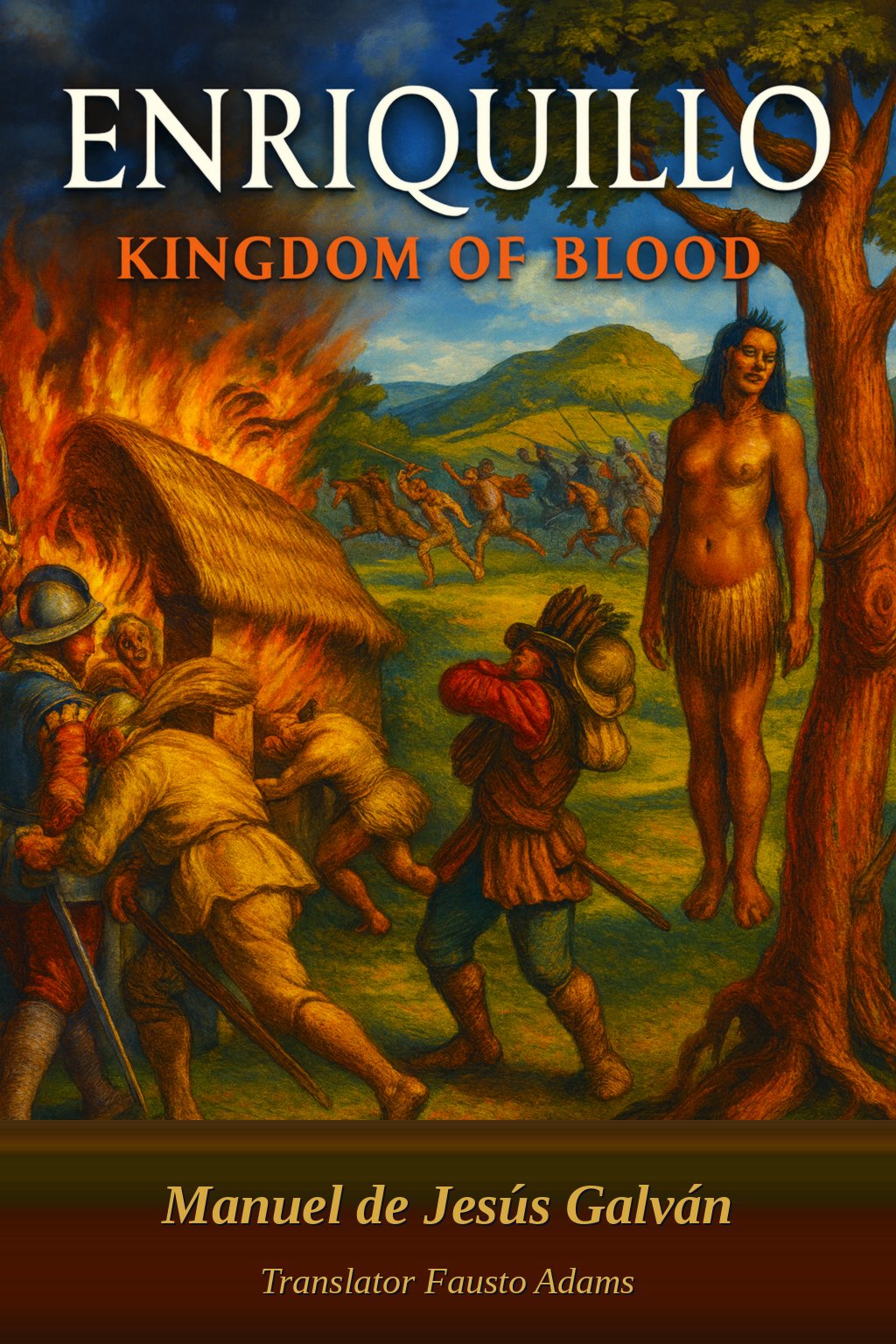
Meanwhile, the Conquest of the Americas was carried out with blood and fire. The sword and gallows exterminated thousands upon thousands of Indians of all classes and sexes. That unfortunate race distinguished itself in vain with acts of sublime self-sacrifice inspired by courage and patriotism. In that cruel war, the conquerors tried in vain to use Indian guides for their operations. The Taínos, with Spartan self-sacrifice, threw themselves off cliffs and died willingly rather than assist in exterminating their brothers. Historical accounts of these acts of high virtue abound.
But the Spanish Army kept appearing everywhere simultaneously, preceded by the roar of their arquebuses, the fierce barking of their hunting dogs, and the cry, glorious in Granada, of “Close Spain!” That cry, untimely and profane on these discovered mountains, came with their blind charge against harmless and defenseless natives.
Stunned, surprised, and terrified by the sudden attacks, the unfortunate Indians burst into pitiful cries and tried to flee, but death met them everywhere at the edge of Castilian swords.
Blood reddened the beautiful valleys of Hispaniola. Fire soon joined the work of extermination, and the straw huts became a burning bonfire, scorching the bodies of those who, paralyzed by terror, remained in their treacherous shelter. Those who fled half-charred from the flames were finished off by the soldiers’ fury, achieving only a quicker death at spear-point. Desolation and devastation reigned throughout all fields.
One Indian warrior, however, stood alone and faced the fierce onslaught with manly courage. Wielding a gleaming Castilian sword, he surprised the soldiers, who didn’t expect to find such spirited courage among so many dismayed fugitives, a formidable lion among timid sheep. Three dead and five wounded lay on the ground, victims of the brave Indian’s blows. The soldiers charged him again, ready to kill him, when an imperious voice commanded: “Hold! Don’t kill him!”
It was Diego Velázquez, rushing forward with drawn sword. From afar, he had seen the brave fighter defending his life heroically, and his generous nature prevailed, inspiring him with the desire to save this brave man.
“Surrender,” he said, “and I will be your friend. No one will harm you.”
“Who believes your words?” replied Guaroa, for it was he, with contempt. “You offered us peace, and we trusted you. Then you came with your men to murder us treacherously. You are false and evil!”
“Surrender!” replied Velázquez, lunging forward and pointing his sword at Guaroa’s chest.
Guaroa dodged sharply, simultaneously unleashing a furious slash that the Spanish captain parried with masterful skill. The two men locked in combat, with Velázquez refusing to let any of his men assist him.
Guaroa’s blows fell like hailstones, but all crashed against the skill and imperturbable coolness of his opponent, who could have pierced the impetuous Indian’s heart a hundred times but sought only to disarm him, which he finally achieved with a skillful counter.
Guaroa rushed to retrieve his sword. When a Spaniard prevented him, the angry warrior drew the dagger from his waist. After moving to stab the man blocking him, finding himself surrounded, he suddenly plunged it into his own chest. “I die free!” he said, and fell to the ground, breathing his last breath a moment later.
Thus, the noble and valiant Guaroa ended gloriously, without bowing his proud head to foreign rule, leaving his lineage an example of invincible bravery and love of freedom that would soon be worthily imitated. Enriquillo did it.
Enriquillo Historical Legend stands as one of literature’s most powerful indictments of slavery and colonialism, yet it is far more than a historical document. This is the epic tale of the first successful indigenous rebellion in the Americas, a fourteen-year resistance (1519-1533) that forced an empire to negotiate with those it sought to enslave. It is the story of a man who chose the dangerous mountains over chains, dignity over subjugation, and death over dishonor.
When Manuel de Jesús Galván penned this masterpiece between 1879 and 1882, he created what José Martí would call “a novel and charming way of writing our American history.” But Galván achieved something greater: he wrote a universal human drama that speaks to every person who has ever faced injustice, every nation that has struggled for self-determination, and every soul that has chosen resistance over submission.
A Story That Changed History
The young boy called Guarocuya watched as Spanish soldiers burned eighty chiefs alive and hanged his great-aunt Anacaona, the beloved poet-queen of Jaragua, on a scaffold built for spectacle. He was four years old. The year was 1503, and the paradise of Hispaniola had become a kingdom of blood.
Renamed Enrique by the Franciscan friars who raised him, the orphaned prince mastered Spanish law, literature, and customs. He became more Spanish than many Spaniards, educated, devout, and loyal to the Crown. He married Mencía, the granddaughter of Anacaona herself, and believed that by following every rule, by being the perfect colonial subject, he could secure justice for his people.
He was wrong.
When corrupt officials stole his lands, assaulted his wife, and threw him in stocks for daring to seek justice through legal channels, Enriquillo finally understood a truth that oppressed peoples throughout history have learned: there are times when the only path to freedom leads through resistance.
With a small band of followers, he fled to the impenetrable Bahoruco mountains. There, he built not merely a rebel camp, but a functioning society, complete with farms, fortifications, and a system of governance that would endure for over a decade. He defeated every army sent against him, sparing the lives of his enemies even as they sought to destroy him. He returned stolen gold to the Spanish rather than keep it for himself. He attended Mass in the wilderness and maintained his Christian faith even while fighting those who claimed to represent it.
His rebellion grew until Emperor Charles V himself, ruler of the largest empire since Rome, was forced to negotiate. In the end, Enriquillo achieved what no indigenous leader in the Americas had accomplished before or would accomplish again: full recognition of his sovereignty, the freedom of his people, and lands where they could live respected by colonial tyranny.
Long before Spartacus became a symbol of slave resistance, before Toussaint L’Ouverture led Haiti to independence, before Gandhi’s peaceful resistance or Mandela’s long walk to freedom, there was Enriquillo. His rebellion in the mountains of Bahoruco represents the first successful indigenous resistance in the Americas, a resistance that ended not in defeat but in recognition, with Emperor Charles V himself acknowledging Enriquillo’s sovereignty.
This historical fact alone makes Enriquillo essential reading for understanding the roots of American independence movements. But the novel’s treatment of this rebellion, showing it as arising not from savage impulse but from exhausted patience, not from hatred but from a desire for justice, makes it a timeless meditation on the nature of legitimate resistance.
A Literary Masterpiece Rediscovered
In 1879, the Dominican writer Manuel de Jesús Galván set out to tell this remarkable story. The result was Enriquillo Historical Legend, a sweeping epic that the great writer, drawing from the eyewitness accounts of Bartolomé de Las Casas, the Spanish friar known as the “Defender of the Indians, created a work that transcends mere historical fiction. Here is a novel of passionate love and bitter betrayal, of court intrigue and mountain warfare, of faith tested and humanity affirmed. Here are characters who leap from the page: the tragic hero Guaroa, who chose death over submission; the villainous Pedro de Mojica, whose greed corrupts everything it touches; the fierce Tamayo, whose rage threatens to consume even his own people; and at the center of it all, Enriquillo himself, noble, patient, and ultimately unconquerable.
For over a century, this masterpiece has been revered throughout Latin America as one of the foundational texts of Caribbean literature. Now, for the first time, it is available in a modern English translation that preserves the elegance and power of Galván’s original while making it accessible to contemporary readers.
Literary Masterwork
This translation brings to modern English readers one of the Spanish language’s great novels, a work that seamlessly weaves together history, romance, and social commentary into a narrative as compelling as any contemporary bestseller. Galván’s genius lies in his ability to humanize all his characters, Spanish and Indigenous alike, showing how systems of oppression corrupt even good people while celebrating those brave enough to resist.
From the historical accounts of Bartolomé de las Casas, Galván created a work that is both meticulously researched and imaginatively rich. Here you will encounter:
• Anacaona, the poet-queen whose artistic genius amazed the Spanish before they betrayed and executed her.
• Mencía, Enriquillo’s beloved wife, whose grace and suffering embody the plight of Indigenous women under colonialism.
• Father Bartolomé de Las Casas himself, the Spanish friar whose crusade for Indigenous rights represents the best of human conscience.
• A cast of conquerors, colonists, and Indigenous leaders whose complex motivations and actions paint a nuanced picture of one of history’s most consequential encounters.
Why This Story Matters Now
We live in an age of reckoning. Around the world, people are confronting the legacies of colonialism, demanding justice for historical wrongs, and asking fundamental questions about freedom, resistance, and reconciliation. Enriquillo speaks directly to these urgent concerns.
This is a story about what happens when legal systems fail the people they are meant to protect. It is about the moment when peaceful petition gives way to righteous resistance. It is about maintaining one’s humanity in the face of inhuman treatment. And it is about the possibility, rare but real, of justice achieved through courage and moral clarity.
The questions Enriquillo raises echo across five centuries: When is rebellion justified? Can oppression be resisted without becoming oppressors ourselves? How do we preserve our dignity when others seek to strip it away? What does reconciliation look like after generations of injustice?
These are not merely historical questions. They are the questions of our moment.
In our contemporary world, where questions of justice, reparation, and historical memory dominate global discourse, Enriquillo offers profound insights into how oppression operates and how it can be resisted. This is not merely the story of Spanish conquerors and Taíno Indians on a Caribbean island; it is the blueprint of colonialism everywhere, the anatomy of resistance in all its forms, and the testament to an indomitable human spirit that transcends race, time, and geography.
The novel’s protagonist, Enriquillo, educated by Franciscan friars, versed in Spanish law and custom, yet denied basic human rights because of his race, embodies the tragic paradox faced by colonized peoples worldwide: mastering the colonizer’s culture only to be rejected by it. His journey from dutiful subject to revolutionary leader mirrors the awakening of oppressed peoples across centuries and continents.
An Invitation
This translation invites you to experience one of the great untold stories of the Americas. It is a story of tragedy and triumph, of love and loss, of oppression and liberation. It is a story that shaped the Caribbean and Latin America, which influenced independence movements from Haiti to Mexico, resonating wherever people struggle for freedom and dignity.
Most importantly, it is a story that affirms the fundamental truth Guaroa spoke as he faced his executioners: that there are things worse than death, and that the human spirit will always rise against them.
This translation invites you to walk with Enriquillo through the mountains of Hispaniola, to witness the birth of resistance in the Americas, and to discover why this novel has been cherished for over a century as one of Latin America’s greatest literary achievements. You will find yourself in a world of court intrigue and mountain warfare, of impossible love and unbreakable loyalties, of cruelty beyond imagination and courage beyond expectation.
Most importantly, you will encounter a story that affirms the fundamental dignity of all human beings and their right to freedom, a story that reminds us that wherever slavery and oppression exist, there too exists the human spirit that declares with Guaroa: “I flee from death, and I flee from slavery, which is worse than death.”
Welcome to Enriquillo Kingdom of Blood, a legend that is history, a history that is prophecy, and a prophecy that speaks to the eternal human hunger for justice and freedom.
Welcome to the story of the First Freedom Fighter of the Americas. Until the end of his days, Enriquillo exercised lordship and mixed rule over a population of four thousand inhabitants, to which number the Indians of all Hispaniola were reduced.
This new translation seeks to make Galván’s masterpiece accessible to contemporary English readers while preserving the elegance and moral force of the original manuscript. The translator tries to accomplish something remarkable. It is to bring Enriquillo’s story to English-speaking readers for the first time in a modern, accessible translation. This is a significant contribution to making Dominican and Caribbean literature available to a wider audience. May it inspire this new generation to reflect on our shared human heritage and our continuing struggle for a better world.
Fausto Adams, Translator
2025