
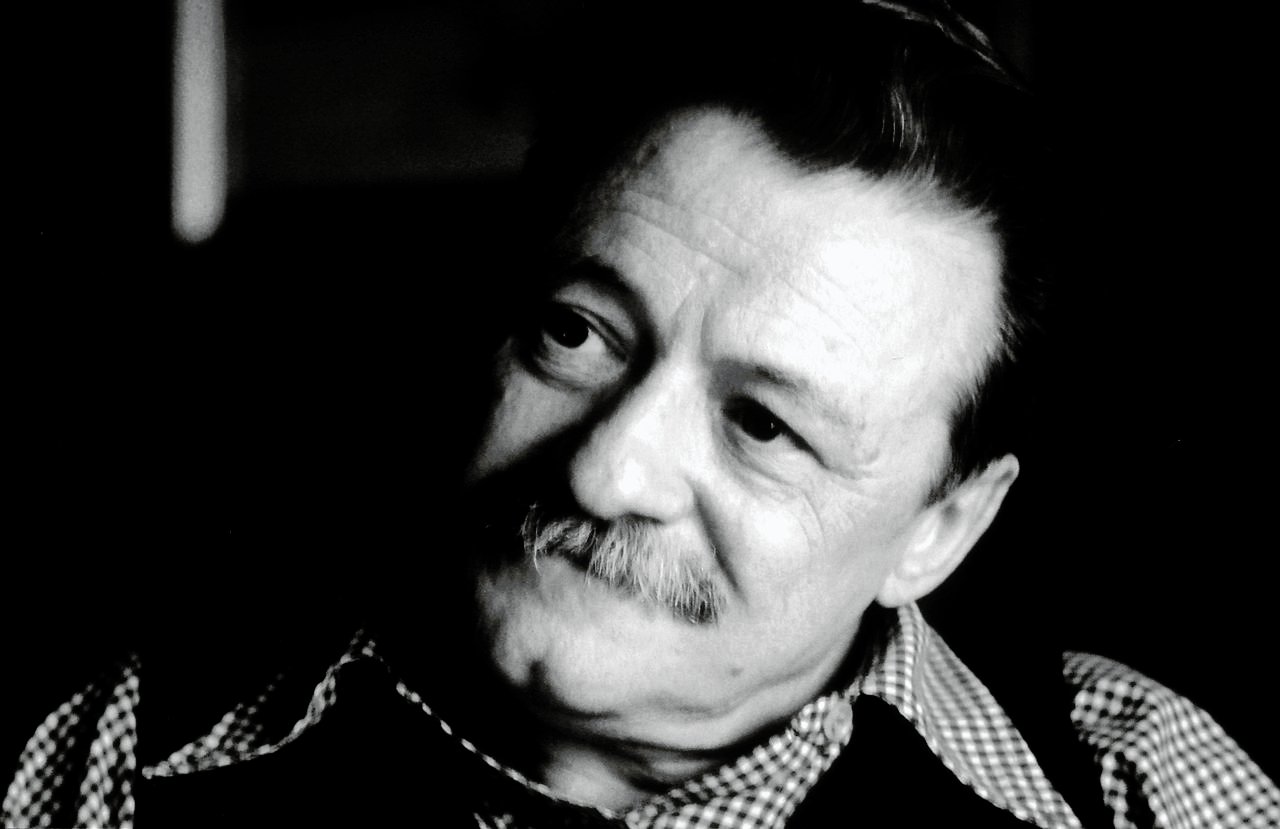
Mario Benedetti
(Paso de los Toros, Department of Tacuarembó, Uruguay, September 14, 1920- Montevideo May 17, 2009)
The Night of the Ugly Ones (Death and Other Surprises, 1968)
This translation of Benedetti’s “La noche de los feos” aimed to preserve both the raw emotional intensity and the precise, almost clinical descriptions of physical deformity that define the original text. The challenge lay in rendering Spanish expressions like “tal para cual” (which became “birds of a feather flock together”) and maintaining the narrator’s bitter yet vulnerable voice without losing the story’s delicate balance between cynicism and hope. Particularly complex were the passages describing the protagonists’ scars—Benedetti’s language is unflinching but never cruel, and capturing that same tone in English required careful attention to word choice, avoiding both euphemism and gratuitous harshness.
The story’s power lies in its progression from mutual recognition through defensive irony to genuine intimacy, culminating in that devastating final scene where touch replaces sight. Translating the shift from “costurón” (which I rendered as “scar” and later “seam”) to the more intimate description of touching required preserving Benedetti’s subtle modulation of register—how the language itself becomes more tender even as it describes damaged flesh. The final image of crying until dawn, “Desgraciados, felices” (Wretched, happy), encapsulates the story’s central paradox: that acceptance of our deepest wounds might be the path to genuine connection. This duality had to remain sharp and unresolved in translation, resisting any impulse to soften or explain what Benedetti leaves beautifully ambiguous.
The Night of the Ugly Ones
Mario Benedetti
Translated by Fausto Adams
1.
We are both ugly. Not even commonly ugly. She has a sunken cheekbone since she was eight, when they did the operation. My disgusting mark next to my mouth comes from a fierce burn that happened at the beginning of my adolescence.
Nor can it be said that we have tender eyes, those sorts of beacons of justification through which the horrible sometimes manage to draw close to beauty. No, not at all. Both hers and mine are eyes of resentment, which only reflect the little or no resignation with which we face our misfortune. Perhaps that’s what brought us together. Maybe “brought together” isn’t the most appropriate phrase. I’m referring to the implacable hatred that each of us feels for our own face.
We met at the entrance to the cinema, standing in line to see two beautiful anybodies on the screen. That’s where for the first time we examined each other without sympathy, but with dark solidarity; that’s where we registered, from the very first glance, our respective solitudes. In the line everyone was in pairs, but they were also authentic couples: spouses, sweethearts, lovers, grandparents, who knows. Everyone—hand in hand or arm in arm—had someone. Only she and I had our hands free and clenched.
We looked at each other’s respective uglinesses carefully, with insolence, without curiosity. I traced the cleft of her cheekbone with the brazen confidence granted to me by my shriveled cheek. She didn’t blush. I liked that she was tough, that she returned my inspection with a meticulous glance at the smooth, shiny, beardless zone of my old burn.
Finally we went in. We sat in different rows, but adjacent ones. She couldn’t look at me, but I, even in the dimness, could make out her neck with its blonde hair, her fresh, well-formed ear. It was the ear on her normal side.
For an hour and forty minutes we admired the respective beauties of the rugged hero and the gentle heroine. At least I have always been capable of admiring what’s beautiful. I reserve my animosity for my face and sometimes for God. Also for the faces of other ugly people, other scarecrows. Perhaps I should feel pity, but I can’t. The truth is they’re something like mirrors. Sometimes I wonder what fate the myth would have suffered if Narcissus had had a sunken cheekbone, or if acid had burned his cheek, or if he were missing half his nose, or had a seam across his forehead.
I waited for her at the exit. I walked a few meters alongside her, and then I spoke to her. When she stopped and looked at me, I had the impression she was hesitating. I invited her to chat for a while in a café or pastry shop. Suddenly she accepted.
The pastry shop was full, but at that moment a table became free. As we passed among the people, the signals, the gestures of astonishment remained behind us. My antennae are particularly trained to capture that morbid curiosity, that unconscious sadism of those who have an ordinary, miraculously symmetrical face. But this time my trained intuition wasn’t even necessary, since my ears were enough to register murmurs, little coughs, false throat clearings. A horrible and isolated face evidently has its interest; but two uglinesses together constitute in themselves a greater spectacle, little less than coordinated; something that must be looked at in company, next to one of those good-looking people with whom the world deserves to be shared.
We sat down, ordered two ice creams, and she had the courage (I liked that too) to take her little mirror from her purse and fix her hair. Her pretty hair.
“What’s happening?” I asked.
She put away the mirror and smiled. The hollow of her cheek changed shape.
“A cliché,” she said. “Birds of a feather flock together.”
We talked at length. After an hour and a half we had to order two coffees to justify our prolonged stay. Suddenly I realized that both she and I were talking with such wounding frankness that it threatened to go beyond sincerity and become an almost equivalent of hypocrisy. I decided to go all in.
“You feel excluded from the world, don’t you?”
“Yes,” she said, still looking at me.
“You admire the beautiful ones, the normal ones. You would like to have a face as balanced as that girl to your right, even though you are intelligent, and she, judging by her laugh, is irredeemably stupid.”
“Yes.”
For the first time she couldn’t hold my gaze.
“I would like that too. But there’s a possibility, you know, that you and I might come to something.”
“Something like what?”
“Like loving each other, damn it. Or simply getting along. Call it what you want, but there’s a possibility.”
She frowned. She didn’t want to conceive hopes.
“Promise not to take me for a madman.”
“I promise.”
“The possibility is to get into the night. Into the complete night. Into total darkness. Do you understand me?”
“No.”
“You have to understand me! Total darkness. Where you don’t see me, where I don’t see you. Your body is beautiful, didn’t you know?”
She blushed, and the cleft in her cheek suddenly turned scarlet.
“I live alone, in an apartment, and it’s nearby.”
She raised her head and now she did look at me, questioning me, finding out about me, desperately trying to reach a diagnosis.
“Let’s go,” she said.
2.
I not only turned off the light, but also drew the double curtain. Beside me she was breathing. And it wasn’t labored breathing. She didn’t want me to help her undress.
I couldn’t see anything, anything. But I could still tell that now she was motionless, waiting. I cautiously stretched out a hand until I found her breast. My touch transmitted to me a stimulating, powerful version. Thus I saw her belly, her sex. Her hands also saw me.
In that instant I understood that I had to tear myself (and tear her) from that lie I myself had fabricated. Or attempted to fabricate. It was like lightning. We weren’t that. We weren’t that.
I had to resort to all my reserves of courage, but I did it. My hand slowly ascended to her face, found the groove of horror, and began a slow, convincing and convinced caress. In reality, my fingers (at first a bit trembling, then progressively serene) passed many times over her tears.
Then, when I least expected it, her hand also reached my face, and passed and repassed over the scar and the smooth skin, that beardless island of my sinister mark.
We cried until dawn. Wretched, happy. Then I got up and drew back the double curtain.
Source: Mario Benedetti
The Night of the Ugly Ones (Death and Other Surprises, 1968)
Books by Mario Benedetti:
The Truce: The Diary of Martín Santomé (Penguin Modern Classics)
Fair Use Disclaimer
This website publishes excerpts of content from other authors under the Fair Use doctrine as permitted by the U.S. Copyright Office (17 U.S.C. § 107) for educational, informational, commentary, and criticism purposes. All excerpted content is properly attributed to its original source and copyright holder. If you believe any content infringes on your copyright, please contact us immediately at admin@faustoadams.com